

UK Company Launches Search Intelligence AI, the World's Most Advanced AI Visibility Platform
A UK-based team has launched Search Intelligence AI, a platform designed to track, analyse, and improve brand visibility across AI search platforms including ChatGPT, Google AI Mode, Gemini, and Perplexity.
The platform enters a growing market as AI-powered search captures an increasing share of how people find information online. Traffic from AI platforms grew 527% year-over-year in 2025. Over 70% of searches now end without a click because users get answers directly from AI assistants rather than visiting websites.
"Most tools in this space tell you whether you're mentioned in AI responses," said the Search Intelligence AI team. "We built something different. Our platform shows you why you're mentioned, what sources AI trusts, and gives you the tools to improve your visibility through better content and targeted link building."
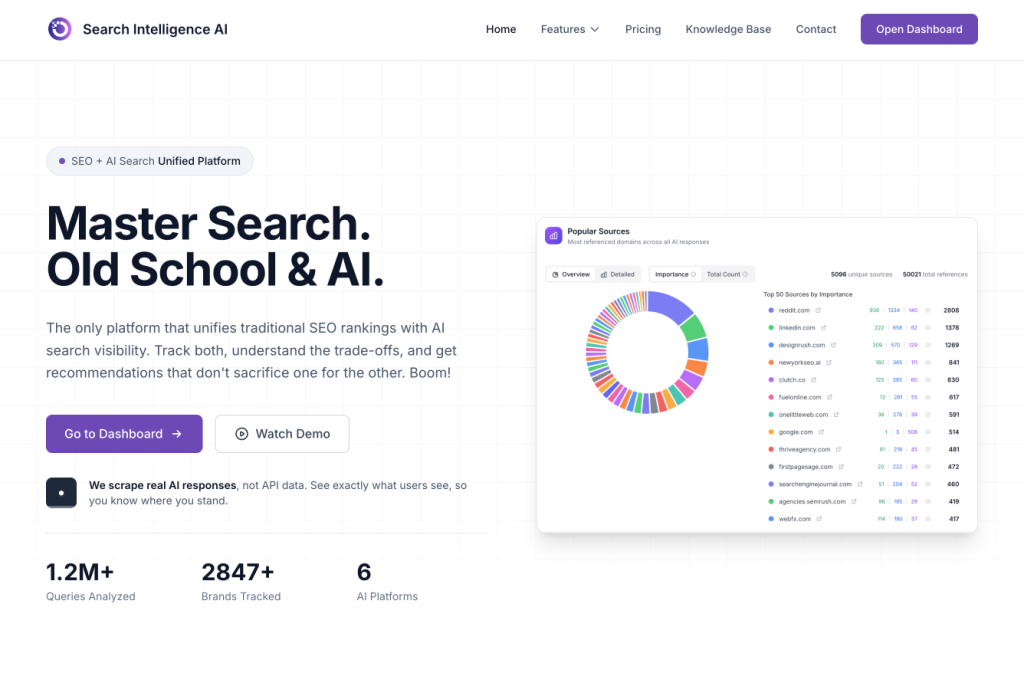
The AI visibility tracking market has grown quickly over the past year. Most available tools share a common limitation: they focus on measurement without providing actionable paths to improvement.
Typical platforms in this category offer basic mention tracking. They tell brands whether they appear in AI responses and count how often. Some use API calls to query AI models, which returns different results than what actual users see in the interface. Others pull from historical databases rather than capturing live responses.
The gap between knowing your visibility and improving it has remained unfilled. Teams export data from tracking tools, then switch to separate content platforms, then use different outreach tools for link building. The workflow is fragmented.
Search Intelligence AI was built to close that gap.
The platform captures actual responses from AI interfaces using proprietary scraping infrastructure. When a user asks ChatGPT a question, Search Intelligence AI sees the same response that user sees, including all citations, source links, and formatting.
This matters because API responses often differ from interface responses. AI platforms display different content, citations, and recommendations through their user-facing interfaces than they return through developer APIs. Tools relying on API calls show an approximation of reality rather than the actual user experience.
Search Intelligence AI tracks four major platforms: ChatGPT, Google AI Mode, Gemini, and Perplexity. These represent the majority of AI search traffic for most industries.
Rather than simple binary mention tracking, the platform uses a weighted scoring formula that reflects how visibility actually works:
- Appearance Rate (35%): How often your brand appears across relevant prompts
- Position Score (25%): Where in the response you're mentioned. First position earns 100 points, second earns 90, and so on
- Visibility Score (25%): How prominently your brand features in the response
- Citation Score (15%): Whether the AI links directly to your content as a source
This scoring system reveals not just whether you appear, but how meaningful that appearance is. Being mentioned fifth in a list of ten alternatives differs significantly from being the primary recommendation with a direct citation.
Most tools count citations as binary: either you're cited or you're not. Search Intelligence AI distinguishes between three types:
Sources: URLs the AI referenced during its research process. These appear in the AI's "sources" or "references" section and indicate what content the AI considered trustworthy for that topic.
Links: URLs presented directly in the response body. These are clickable links that users see and can follow.
Citations: Direct quotes with attribution. The AI explicitly quotes your content and attributes it to your brand or domain.
Understanding these distinctions helps teams identify what type of content earns each citation type. A page might be sourced frequently but rarely linked directly. Another might earn direct quotes for specific data points. These patterns inform content strategy.
The platform's most significant differentiator is its integrated action tools. Tracking visibility matters little if teams can't act on the insights.
Five-Stage Content Brief Generator
The content brief system uses a multi-stage research pipeline rather than simple AI prompting:
Stage 1 - Query Collection: The system gathers search queries related to your target topic, identifying the questions your audience actually asks.
Stage 2 - SERP Analysis: It fetches top-ranking pages from search results for each query, building a picture of what currently performs well.
Stage 3 - Content Scraping: The platform scrapes competitor content directly, extracting the actual text, structure, and sources they use.
Stage 4 - Data Extraction: It analyses 40+ data points from each competitor page, including headings, word counts, topics covered, sources cited, and content gaps.
Stage 5 - Brief Generation: Finally, it generates briefs with recommended structure, topics to cover, sources to cite, and content gaps to fill.
Every URL referenced in a brief comes from scraped content. The system cannot hallucinate sources because it only cites verified, scraped pages. This solves a common problem with AI-generated content recommendations.
Brief generation takes 15-30 minutes per topic due to the extensive scraping and analysis involved. The result is a research document, not a quick AI summary.
Link Building Recommendations
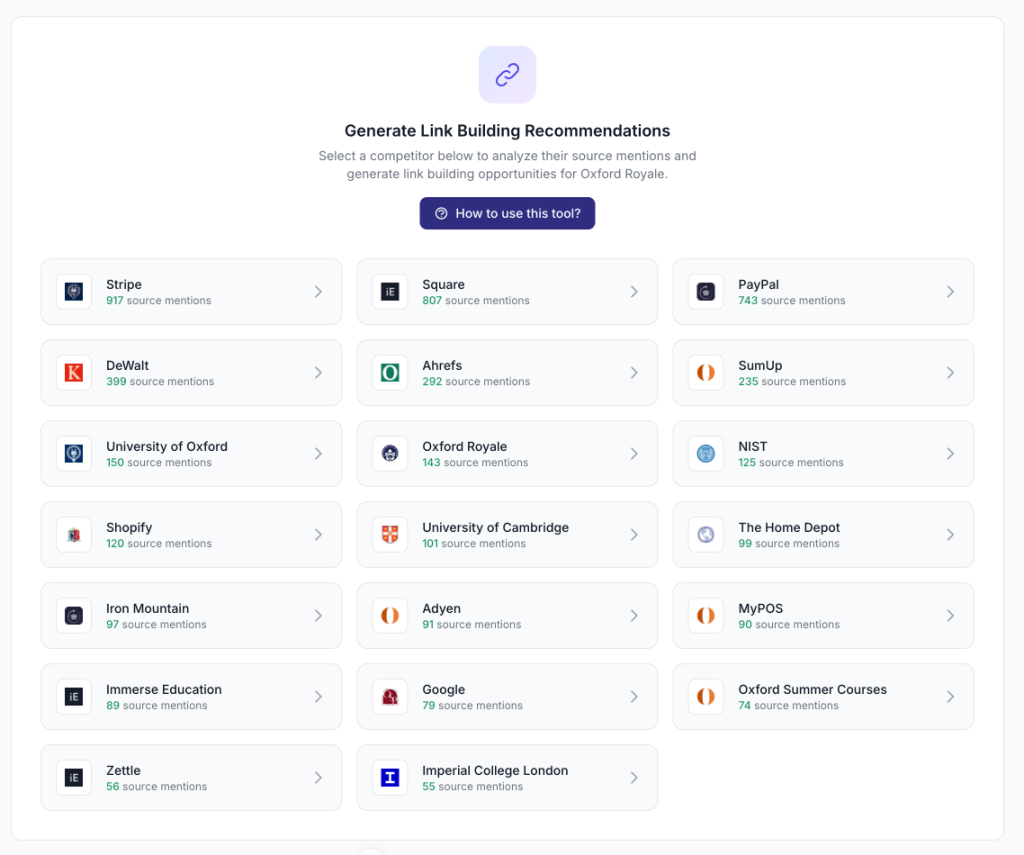
The link building system identifies warm outreach targets based on citation patterns. It finds pages that cite your competitors but don't mention you.
These represent fundamentally different prospects than cold outreach lists. The site owners have already demonstrated interest in your topic. They're linking to similar content in your space. The outreach conversation starts from a position of relevance.
The platform categorises opportunities by page type:
- Listicles: "Top 10" and "Best of" posts where adding another recommendation is natural
- Comparisons: Articles comparing options where your brand could be included
- Guides: Educational content where your resource could serve as a source
- Reviews: Product or service reviews covering your category
Each opportunity includes probability scores based on historical success rates for that page type and domain authority combination.
Digital PR Ideation
The Digital PR system generates expert commentary ideas and PR angles based on your content and industry trends.
It identifies opportunities for original research, data studies, and thought leadership pieces that journalists cover. These PR-worthy content ideas are designed to earn high-authority backlinks and media mentions. Such coverage directly influences how AI platforms perceive your brand's expertise and trustworthiness.
The system analyses what topics are gaining traction, what angles are underserved, and what data your organisation could uniquely provide. The output is a prioritised list of PR opportunities with suggested angles and target publications.
AI visibility doesn't exist in isolation. Pages that rank well in traditional search tend to earn more AI citations. The platform includes built-in Google and Bing ranking tracking alongside AI visibility metrics.
Teams can correlate which pages rank organically and which get cited by AI platforms. Patterns emerge: certain content types, certain sources, certain structures appear to influence both traditional rankings and AI citations.
Desktop and mobile rankings are tracked separately. Featured snippet detection identifies which queries your content answers directly in Google's search results, a strong signal for potential AI citation.
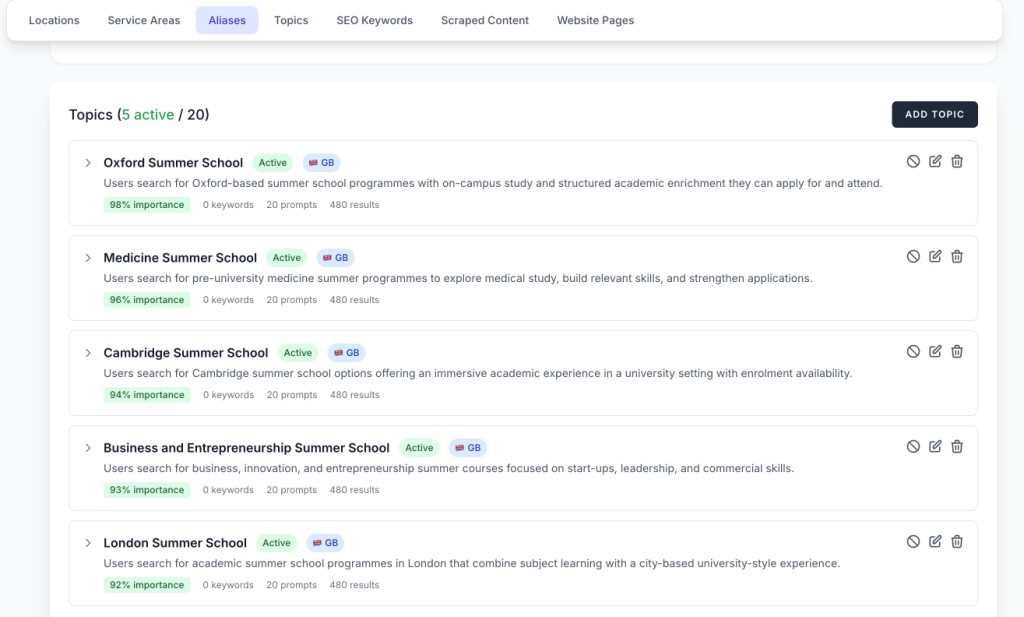
Prompts are organised by topic rather than flat keyword lists. Each topic can have its own location targeting and search intent classification.
This structure mirrors how businesses think about their markets. A software company might track topics like "CRM comparison," "sales automation," and "customer data platforms" rather than managing hundreds of individual keywords without context.
Each topic contains multiple prompts representing different ways users ask about that subject. The platform aggregates data across prompt variations to provide statistically meaningful visibility scores.
Search Intelligence AI launches with introductory pricing for early adopters:
- Launch Offer: £99/month for users joining in the first week
- Growth: £250/month (£199/month annual) for 3 brands, 10 topics each, 20 prompts per topic, plus 50 SEO keywords per brand
- Enterprise: £1,200/month (£999/month annual) for 10 brands with expanded limits
All plans include the full feature set: AI visibility tracking, content brief generation, link building recommendations, Digital PR ideation, and traditional SEO tracking.
The timing reflects a fundamental shift in how people find information. AI platforms are becoming primary discovery channels for many queries. Brands that understand and optimise for this shift will capture attention that competitors miss.
The tools available until now have focused on measurement. Knowing your visibility score matters, but it's the starting point, not the destination. Search Intelligence AI provides the complete workflow from insight to execution.
"We built this for SEO teams who want to act, not just observe," the team noted. "The content briefs, link building recommendations, and PR ideation features exist because we know tracking alone doesn't move the needle. Execution does."
The platform is available now at search-intelligence.ai. Teams can request a demo to see the visibility tracking, content brief generation, and link building tools in action.
Early adopters joining in the first week lock in the £99/month launch pricing.